This post contains affiliate links. If you purchase through my links, I may earn a small commission at no extra cost to you. I only recommend products I genuinely use or have thoroughly researched.
There’s something about the end of a long day — any day — that makes the first step of a routine feel like it matters more than it should.
There was a phase when I thought a tight face after washing meant clean skin. I know. But nobody had told me otherwise, and the foaming cleanser I was using felt efficient — that satisfying squeak-and-rinse I mistook for thoroughness. It wasn’t until my skin started looking more tired than I felt that I stopped and asked: what is this cleanser actually doing?
In this article, you’ll learn:
- Why the stripping feeling after cleansing may be working against your skin barrier
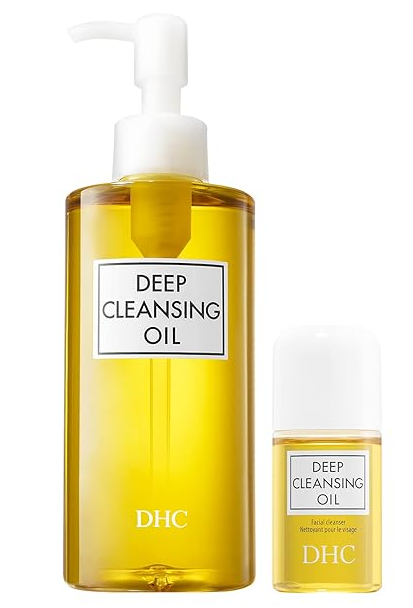
- What’s actually in DHC Deep Cleansing Oil — including an honest note about the rosemary question
- How it compares to two Japanese alternatives
- Exactly how to use it so the emulsification actually works
Quick Comparison: Japanese Oil Cleansers
| DHC Deep Cleansing Oil | FANCL Mild Cleansing Oil | Kose Softymo Speedy | |
|---|---|---|---|
| Base oil | Organic olive oil | Meadowfoam seed oil | Mineral + plant blend |
| Price / fl oz | ~$3.21 | Higher (verify current listing — US availability inconsistent) | ~$1.00 |
| Fragrance-free? | Contains rosemary leaf oil (see below) | Yes, fully | Yes |
| US availability | Amazon, Ulta, Sephora, Walmart | Limited | Amazon (Japan stock) |
| Best for | Dry to normal skin, oil cleansing beginners | Fragrance-sensitive or reactive skin | Budget-conscious, lighter texture |
Hana’s note: If I were recommending a first oil cleanser to someone starting out, it would be DHC — not because it’s perfect, but because it’s reliable and easy to find.
Who DHC works best for: Dry to normal skin. Women who’ve never tried oil cleansing and want something forgiving.
When you might prefer something else: Fragrance sensitivity. Oily or breakout-prone skin. If you want zero scent compounds — FANCL is the cleaner choice.
Why Oil Cleansing Makes Sense for Dry Skin
The premise is simple: oil dissolves oil. The impurities on your face at the end of the day — sunscreen, sebum, foundation — are largely oil-based. A foaming cleanser’s surfactants go after everything without much discrimination. That’s where the tightness comes from.
Research published in the journal Cosmetics found that after surfactant exposure, transepidermal water loss increased significantly and stratum corneum hydration decreased, at least in the short term. For skin that already leans dry or barrier-compromised, that post-wash tightness isn’t just uncomfortable — it may be making the moisturizer that follows harder to absorb.
An oil cleanser bypasses much of this. Massaged onto dry skin, it bonds with oil-based debris. Add water, and the emulsifier turns it milky — and it rinses away cleanly, taking the day’s buildup with it.
What’s in DHC Deep Cleansing Oil
Full INCI: Olea Europaea (Olive) Fruit Oil, Caprylic/Capric Triglyceride, Sorbeth-30 Tetraoleate, Pentylene Glycol, Tocopherol, Stearyl Glycyrrhetinate, Rosmarinus Officinalis (Rosemary) Leaf Oil, Phenoxyethanol
Eight ingredients. That’s it.
Organic olive oil
Olive oil is the cleansing vehicle. It has a comedogenic rating of around 2 on the standard scale — low-to-moderate for most people, though those with oily or breakout-prone skin may want to pay attention. In a rinse-off emulsifying formula like this one, the concern is different from a leave-on application: a study in Pediatric Dermatology found that leave-on olive oil over several weeks reduced stratum corneum integrity in adult volunteers — but that’s leave-on use, not a rinse-off cleanser. The emulsification here means very little oil remains on skin after rinsing.
Tocopherol (vitamin E)
Experimental research suggests tocopherol may act as a free-radical scavenger against environmental stressors, though robust controlled clinical evidence for topical applications remains limited. It’s still something I reach for in a cleanser formula. The ingredient has decades of use in Japanese skincare — and at rinse-off concentrations, it’s low-stakes and reassuring.
A note on rosemary leaf oil — and the “fragrance-free” question
The product is labeled “Fragrance and Colorant Free.” I want to be direct: DHC Deep Cleansing Oil contains Rosmarinus Officinalis (Rosemary) Leaf Oil. When you use it, you will notice a faint herbal scent. It’s subtle, but it’s there.
This doesn’t make the product unsafe. For most women it won’t be an issue. But if you have known sensitivity to botanical essential oils, FANCL Mild is the cleaner alternative.
Stearyl Glycyrrhetinate
A licorice-derived skin-conditioning ingredient, long used in Japanese skincare formulas for its traditionally soothing properties. I notice its absence in formulas that feel more stripping.
Japan’s Double Cleansing Ritual — and What 丁寧 Has to Do With It
I didn’t grow up thinking of face washing as a practice. It was a task. Something to finish before moving on.
What changed was learning the Japanese concept of 丁寧(teinei)— to do something with full attention and care, without cutting corners, because the thing itself is worth that quality of attention.
In Japan’s skincare tradition, the evening cleanse is the beginning of the skin’s night. The oil goes on dry hands and a dry face. You take sixty seconds to work it in. You let the emulsification happen before rinsing.
I think about this often with the women I write for — not the ones who aren’t trying hard enough. Women who are already carrying too much.
They’ve spent years scrubbing quickly and wondering why nothing seems to absorb. The cleanser isn’t a throwaway step. It’s the first conversation your skin has each night. Showing up for it — even just a little — changes what comes after.
How to Use It: The Part Most People Get Wrong
The mistake is starting with wet skin. Oil and water don’t mix yet — that’s the whole point.
Step 1 — Dry hands, dry face. Pump 2–3 pumps into dry palms. Apply to a completely dry face.
Step 2 — Massage for 30–60 seconds. Work it across the face in gentle circular motions. You’ll feel the oil warming and picking up the day.
Step 3 — Add water to emulsify. Wet your hands only, then bring them to your face. The formula turns milky — this is the emulsification. Keep massaging for 15–20 seconds.
Step 4 — Rinse thoroughly. Lukewarm water, not hot. Make sure the milky residue is gone.
Step 5 — Second cleanse (optional). If you wore sunscreen or long-wear makeup, a water-based cleanser picks up anything remaining. For dry skin with lighter products, one step is often enough.
Morning or evening? Evening, primarily. I use a splash of water in the morning and save the oil cleanse for when there’s actually something to remove.
Patch test recommended, especially for sensitive skin, before adding this to your routine.
FAQ
Is DHC Deep Cleansing Oil truly fragrance-free?
The “Fragrance and Colorant Free” label refers to added synthetic fragrance. However, it contains Rosmarinus Officinalis (Rosemary) Leaf Oil, which has a natural botanical scent. If you have fragrance sensitivity or are strictly avoiding all scent compounds, FANCL Mild Cleansing Oil is the better choice.
Will olive oil clog my pores?
Olive oil has a comedogenic rating of around 2 — low-to-moderate for most. The key context: this is a rinse-off formula that emulsifies before washing away. Pore-clogging concerns typically apply to leave-on oils, not rinse-off cleansers. For dry to normal skin, clogging is unlikely. For oily or breakout-prone skin, do a patch test and watch how your skin responds over the first few weeks.
How long does a bottle last?
At 2–3 pumps per evening use, a 6.7 fl oz bottle lasts most women three to four months. Double-cleansing morning and evening? Closer to six to eight weeks.
Where to Buy
→ DHC Deep Cleansing Oil, 6.7 fl oz on Amazon
Currently around $21.49 for 6.7 fl oz — check the current Amazon listing for the latest price. Also available at Ulta, Sephora, and Walmart. On Amazon, confirm the seller is Amazon.com directly. Ulta and Sephora ship from DHC US, which is the most reliable option.
Closing
There is no version of a skincare routine that works if what’s stripping you away comes first.
Slow down at the beginning. Give the oil sixty seconds. The serums and moisturizers that follow — they absorb differently when the skin wasn’t stripped first.
If you’ve been using this or another Japanese oil cleanser, I’d love to know how it’s going. Drop a question or a thought in the comments.
→ Find DHC Deep Cleansing Oil on Amazon
丁寧に洗うことは、自分を大切にすることの、最初の一歩。 “To wash with care is the first small act of tending to yourself.”
Author Bio
Hana is a J-Beauty writer based in Japan who spent most of her busiest years too busy to think about skincare — and paid for it in dullness, dryness, and a face that looked more tired than she felt. Now she writes about going slower and choosing better, for women who are finally ready to start.