This post contains affiliate links. If you purchase through my links, I may earn a small commission at no extra cost to you. I only recommend products I genuinely use or have thoroughly researched.
I was getting eight hours of sleep. I was doing everything right. And I was still dragging myself through the afternoon like I’d forgotten how to be a person.
That wasn’t burnout in any dramatic sense. It was quieter. A low hum of not-quite-enough that no amount of coffee or early nights seemed to touch.
In this article, you’ll learn:
- What adaptogens actually do — and what they don’t
- Why “adrenal fatigue” is a contested term, and what Hana uses instead
- The five key herbs in Gaia Herbs PRO Daytime HPA, honestly assessed
- Whether it’s worth $35.50
- How to build a realistic daily ritual around it
At a Glance
| Category | Product | Why Hana Likes It | Where to Buy |
|---|---|---|---|
| Best Overall | Gaia Herbs PRO Daytime HPA | Five well-studied adaptogens; standardized extracts; purity-tested | Amazon → |
| Best for First-Timers | 60-cap / 30-day | Lower commitment before scaling | Amazon → |
| Best Value | 120-cap / 60-day | $0.49/cap vs $0.59/cap | Amazon → |
| Hana’s Daily Choice | Daytime HPA | Rhodiola + ashwagandha + schisandra (五味子) combination closest to East Asian tradition I’ve found in a US-available product | Amazon → |
| Best Timing | Autumn and winter | In Japan, autumn is when 養生 practitioners emphasize rebuilding reserves before the cold months | — |
養生(Yōjō)and the Art of Preparing, Not Repairing
There’s a Japanese health philosophy called 養生 — yōjō. The closest translation I have is “tending to your life.” Not treating illness. Not optimizing performance. Tending.
I grew up with this idea in the background without fully understanding it. It was in the way certain foods were described as “building” or “draining,” in the quiet insistence on hot meals in cold months. It wasn’t until I started researching my own sustained energy deficit that yōjō came into focus as a framework.
Adaptogens fit inside yōjō almost perfectly. Not because they’re Japanese in origin — most aren’t — but because the logic is identical. You take them every day, quietly, so that hard weeks land differently. The effect builds over time, like tending something. That’s not a marketing line. It’s how the research actually describes it.
One word I won’t use: “adrenal fatigue.” It isn’t a recognized medical diagnosis. What I can say — what the science does support — is that the body’s stress response system can shift under sustained load. Cortisol rhythms can change. Recovery can feel qualitatively different. That experience is real. The label is contested. I use “stress response support” instead.
What Adaptogens Actually Do
The word “adaptogen” was coined in the 1940s by Soviet scientist Lazarev. To qualify, a substance must be non-toxic at normal doses, increase non-specific resistance to stress, and help normalize physiological function that has drifted out of range.
That last criterion is what I find most interesting. An adaptogen isn’t supposed to push your system in one direction — some research suggests it works more like a thermostat, bringing things toward balance whether the problem is too much stimulation or too little.
The mechanism most studied is the HPA axis: the hypothalamus-pituitary-adrenal loop that governs how the body detects and responds to stress. Under sustained load, this loop can become dysregulated. Cortisol rhythms shift, the system becomes less precise, and the ordinary cadence of tired-at-night and alert-in-the-morning starts to blur.
What the research actually shows:
A 2023 systematic review and meta-analysis in the Journal of Functional Foods found that mentally stressed adults who took ashwagandha daily had significantly lower cortisol levels after 56–60 days compared to placebo. A 2021 randomized controlled trial in the Journal of Obstetrics and Gynaecology Research found that ashwagandha relieved mild to moderate hormonal-shift symptoms better than placebo in 91 participants. These are promising findings. They are not the final word.
Rhodiola and schisandra have shorter Western clinical records. Their inclusion in traditional East Asian and Ayurvedic systems spans centuries — and that’s not nothing, even if it isn’t the same as a large RCT.
Hana’s Honest Assessment: Gaia Herbs PRO Daytime HPA
The PRO line uses standardized extracts with measurable active compounds. The rhodiola in this formula is standardized to 6mg rosavins per serving — a number you can evaluate, not just “rhodiola extract” on a label.
The formula uses liquid phyto-caps: the extract suspended in vegetable glycerin and olive oil rather than dry powder. This matters for absorption of fat-soluble compounds. The olive oil base isn’t incidental — it’s how I know the formulator thought about bioavailability, not just marketing.
Per 2-capsule serving:
- Siberian Rhodiola root extract: 120mg (rosavins 6mg)
- Holy Basil leaf supercritical CO₂ extract: 32mg (eugenols 3.86mg)
- Proprietary Blend 520mg: Organic Oats milky seed / Organic Holy Basil leaf / Schisandra berry / Ashwagandha root extract
- Other: vegetable glycerin / water / hypromellose capsule / olive oil
Vegan. Gluten-free. Soy-free. Purity-tested — which matters to me because I’ve learned to read those certifications as a proxy for how seriously a brand thinks about formulation.
Pros:
- Standardized active compounds — dose is evaluable, not decorative
- Liquid phyto-cap format absorbs well
- Five adaptogens in genuine synergy
- Contains schisandra (五味子 / gomishi) — rare in US-market products, and meaningful to me for reasons I’ll explain
- Amazon’s Choice; 4.7/5 from 339 reviews; 200+ purchased per month
Cons:
- $35.50 for 30 days is a real ongoing cost; the 120-cap version at $58.50 is meaningfully better value per capsule
- Effects build over 6–12 weeks; if you expect to feel different in a week, you will be disappointed
- The proprietary blend means individual doses of ashwagandha, schisandra, and milky oats aren’t disclosed
Who this is for: Women who’ve lived in their skin long enough to recognize a sustained energy shift sleep isn’t solving. Women who want a daily foundation, not an acute fix.
Who should speak to their doctor first: Anyone with bipolar disorder (rhodiola is contraindicated). Anyone taking thyroid medication or antidepressants. Anyone pregnant or breastfeeding. Anyone with nightshade sensitivity (ashwagandha is in the nightshade family).
As with any new supplement, discuss with your healthcare provider before starting, especially if you’re managing a medical condition or taking prescription medications.
→ Check current price on Amazon
The Herbs: What Each One Is Actually Doing
Rhodiola — The Endurance Adaptogen
Rhodiola rosea grows in the cold, rocky highlands of Siberia and Scandinavia. Traditionally used by Soviet researchers in their earliest adaptogen studies, it’s now one of the better-studied herbs in this category.
A randomized, placebo-controlled study published in Planta Medica found that four weeks of daily rhodiola extract significantly reduced fatigue symptoms and improved attention scores compared to placebo in people with stress-related fatigue syndrome. A systematic review of 11 randomized trials found mixed results across studies, with the authors noting methodological variability — so the picture isn’t settled.
What I can say from my own experience: the afternoon used to require a decision every day. It doesn’t anymore. That’s not a controlled trial. It’s my life.
One note: rhodiola is a mildly stimulating adaptogen. Morning only. Not for people with bipolar disorder.
Ashwagandha — For the “Wired and Tired” Pattern
Ashwagandha (Withania somnifera) is the adaptogen with the most robust Western clinical data, particularly for the pattern of being exhausted but unable to settle. The 2023 meta-analysis linked above is the strongest recent evidence for cortisol reduction. The 2021 RCT specifically studied hormonal-shift symptoms.
The exact ashwagandha dose within the 520mg proprietary blend isn’t disclosed — a limitation worth naming. What the formula can’t hide is whether it works. For me, it has.
Holy Basil, Schisandra (五味子), and Milky Oats — The Quieter Support
Holy basil (Ocimum sanctum / tulsi) appears twice in this formula — as a standardized supercritical extract and within the proprietary blend. That repetition tells me the formulator considered it central. Some research points to its potential role in cortisol and blood pressure balance. I think of it as the quieter one in this formula — not the headliner, but the thing that makes the other herbs work better. That’s hard to quantify, and I’m okay with that.
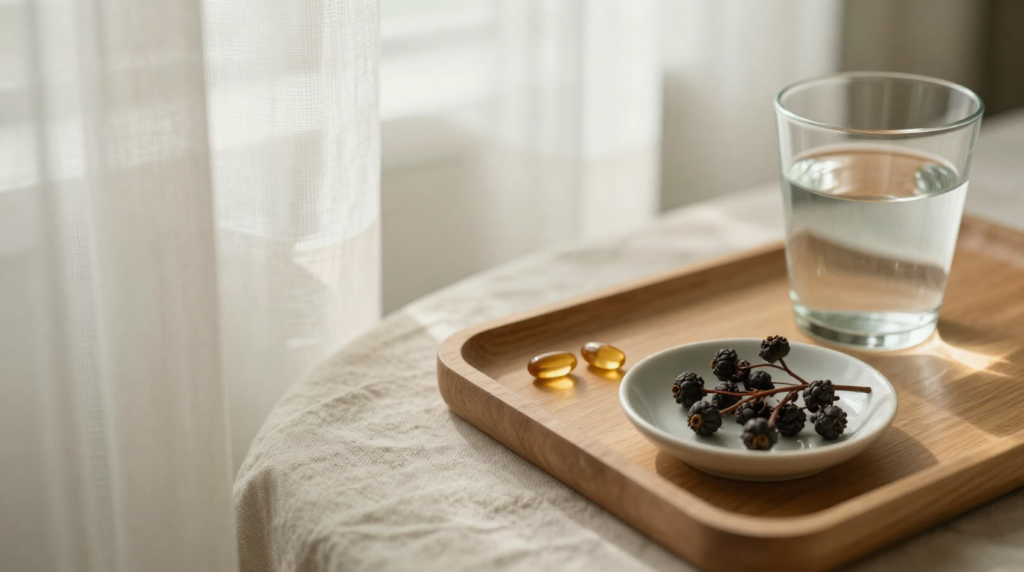
Schisandra is where I want to stay for a moment. In Japan it’s known as 五味子 — gomishi. The name means “five-flavored fruit”: sweet skin, sour flesh, bitter and spicy seeds, and an overall salty quality. It holds an official monograph in the Japanese Pharmacopoeia, and has been used in Japanese Kampo medicine for vitality and resilience support. Seeing it in a US supplement formula — at a real dose, not a trace — felt like recognition.
Milky oats (Avena sativa, milky seed stage) is what traditional herbalists call a nervine — an herb that works on the nervous system toward calm without sedating. The clinical research is limited. Its history of use is long and cross-cultural. I hold both of those things without resolving the tension.
How to Build a Ritual That Sticks
Take 2 capsules with breakfast — a meal with some fat helps absorption of the oil-based extract. Do not take in the evening; rhodiola is mildly stimulating.
You can take an additional 2 capsules in the afternoon, as the label suggests. I stayed at 2 in the morning. Adding more didn’t change my experience in any way I could clearly attribute.
What working looks like: Not a dramatic shift. More like the removal of a low-grade drag. Things that used to feel effortful begin to feel ordinary. Give it 8–12 weeks before evaluating.
Signs to reassess: New headaches, elevated anxiety, worse sleep quality, or anything that feels off. Stop and speak with your doctor.
FAQ
How long until adaptogens work? Most practitioners suggest 6–12 weeks of consistent daily use. Some people notice something subtle by weeks 3–4. If you’re evaluating after two weeks and feeling nothing, that’s not the formula failing — that’s the formula still building.
Can I take this with thyroid medication or antidepressants? This is a conversation for your doctor. Ashwagandha in particular has documented potential interactions with thyroid hormones and some antidepressants. Bring the label to your prescriber before starting.
Is rhodiola safe if I’ve had depression? Rhodiola is contraindicated for bipolar disorder per the product label. For unipolar depression, the picture is more nuanced — rhodiola is mildly stimulating, which can be destabilizing for some. Your doctor is the right source for your specific situation.
Can this replace coffee? No. Adaptogens don’t provide acute stimulation. What some people find is that their baseline shifts over time, so the coffee feels less urgent. But if you’re hoping to swap one for the other on day one, you’ll be disappointed.
Your Body Isn’t Broken. It’s Asking for Something Different.
The exhaustion that brought you here — the one that sleep didn’t fix, that coffee didn’t fix — that’s real information. It’s your body adjusting to a new set of demands, often without being given new tools.
Adaptogens aren’t the whole answer. They’re one piece of a larger picture that includes sleep, stress load, and the things in your life that drain versus restore. But they’re a piece I’ve found worth holding.
Start with the 60-cap bottle to see how your body responds before committing to the larger size. Take it with breakfast, same time every day. Give it 8–10 weeks. Notice what changes — and what doesn’t. Both are information.
→ Gaia Herbs PRO Daytime HPA on Amazon
Have you tried adaptogens? I’d love to hear what’s worked — or not — in the comments.
五味子の五つの味は、それぞれが体の別の声を聞いている。 “The five flavors of gomishi — each one listening to a different voice in the body.”
Author Bio
Hana is a J-Beauty writer based in Japan who spent most of her busiest years too busy to think about skincare — and paid for it in dullness, dryness, and a face that looked more tired than she felt. Now she writes about going slower and choosing better, for women who are finally ready to start.