This post contains affiliate links. If you purchase through my links, I may earn a small commission at no extra cost to you. I only recommend products I genuinely use or have thoroughly researched.
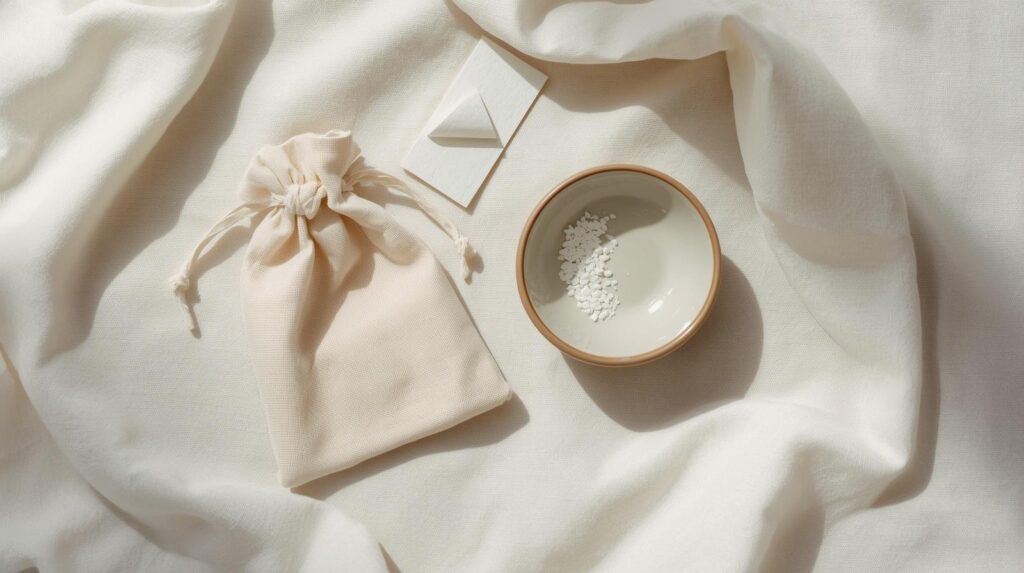
I was 33, lying in bed at 11:30pm with a body that was exhausted and a mind that absolutely refused to cooperate. Not anxious about anything specific. Just… awake. That particular kind of tired where closing your eyes doesn’t actually help.
I’d tried everything the articles recommended. Melatonin. No screens after 9. The same chamomile tea, night after night. And still, there I was. Staring at the ceiling. Wondering when this started feeling so hard.
In this article, you’ll learn:
- Why hormonal shifts in your late 30s and 40s change the way your body manages sleep — and where magnesium fits in
- The real difference between magnesium chloride flakes and the Epsom salt you’ve probably already tried
- How Japanese bathing culture reframes the whole thing — not as a sleep hack, but as something gentler
- Which magnesium bath products Hana actually recommends, and one to skip
Quick Comparison: 3 Magnesium Bath Options
| Ancient Minerals Bath Flakes | Yareli Dead Sea Flakes (5lb) | Dr. Teal’s Combo Pack | |
|---|---|---|---|
| Source | Zechstein seabed, 1,500m underground | Dead Sea, Israel | Manufactured MgSO₄ |
| Key ingredient | Magnesium chloride (MgCl₂) | Magnesium chloride (MgCl₂) | Magnesium sulfate (MgSO₄) |
| Additives | None. Fragrance-free | None. Fragrance-free | SLS, fragrances, MI/MCI preservatives |
| Price range | ~$25–$35 / 4.4lb | ~$20–$28 / 5lb | ~$12–$18 / combo |
| Best for | Sensitive skin, purity-focused, nightly ritual | Budget-conscious, Dead Sea fans, first try | Skip it |
| Hada Ritual pick? | ✅ Primary recommendation | ✅ Solid alternative | ❌ Not recommended — see why below |
Why skip Dr. Teal’s? The foaming bath contains sodium lauryl sulfate (SLS) — a surfactant documented to disrupt skin barrier function — and methylisothiazolinone (MI), a preservative the European Union banned from leave-on cosmetics in 2017 due to sensitization concerns. For women navigating hormonal shifts and barrier changes, that’s the opposite of what we want in a wind-down ritual. The “Pure Epsom Salt” branding is also misleading — third-party reviewers note the foaming bath contains very little actual magnesium.
Already decided? → Ancient Minerals on Amazon
The Sleep Problem No One Is Talking About in Your 40s
When exhaustion and wakefulness live in the same body
There’s a specific kind of tired that starts in your late 30s. It’s not the tired you feel after a bad night — it’s deeper than that. You’re tired during the day and then frustratingly awake at night. You fall asleep fine sometimes, then wake up at 3am with a brain that decides now is an excellent time to process everything.
This is not a character flaw. It’s physiology.
Why hormonal shifts deplete magnesium — and what that has to do with your nights
During perimenopause, estrogen and progesterone begin to fluctuate. Progesterone has a calming effect on the brain — research confirms it works through GABA-A receptors, the same pathways associated with relaxation and sleep. As progesterone declines, some research links this to increased nighttime alertness and lighter sleep in some women.
At the same time, magnesium levels in the body tend to decrease with age — a pattern documented across multiple studies, due to reduced dietary intake, impaired absorption, and increased urinary loss. Stress, caffeine, and modern diets that are already falling short compound the problem.
Some research suggests magnesium plays a role in regulating GABA activity — a double-blind clinical trial found it may support the nervous system’s ability to shift into rest mode. Other studies indicate magnesium supplementation may support cortisol regulation — one study in elderly subjects found a significant drop in nocturnal cortisol alongside improved sleep architecture. The evidence is genuinely promising — though still evolving, especially for the transdermal route specifically.
The short version: your body may need more magnesium than it’s getting, and the timing — right when sleep is already getting harder — is not a coincidence.
Magnesium Chloride vs. Epsom Salt: What’s Actually the Difference?
Same mineral family, different compound
The difference between magnesium chloride and Epsom salt is simpler than it sounds — same mineral, different compound, and it matters for how the bath feels.
Epsom salt is magnesium sulfate (MgSO₄). Magnesium bath flakes are magnesium chloride (MgCl₂). Both contain magnesium. Both dissolve in water. Magnesium chloride is generally noted for its fast dissolution and the noticeably silkier feel it creates in warm water — though a direct peer-reviewed comparison of dissolution rates isn’t something I could track down. The practical experience is real, even if the mechanism hasn’t been formally published outside of brand documentation.
Why MgCl₂ and what that means for your skin
The faster, more complete dissolution means more of the mineral is available in the bathwater. Whether that translates to meaningfully more absorption through the skin is — and here I want to be honest with you — still debated.
The honest note on transdermal absorption — what we know, what we don’t
An unpublished report from University of Birmingham researchers found that 16 out of 19 participants showed some increase in blood magnesium levels after magnesium sulfate baths, though the increases were small. Urinary magnesium increased more consistently. Note: this report has not been peer-reviewed and is cited here alongside a 2017 review that examined it critically.
A 2017 review published in Nutrients concluded that while transdermal magnesium absorption does appear to occur, the degree to which it meaningfully supplements the body’s magnesium levels is not yet established.
What does this mean in practice? A magnesium bath is not a substitute for adequate dietary magnesium or oral supplementation if you’re deficient. What it is — reliably, consistently, for many women — is a warm, intentional wind-down ritual with a physiological basis for relaxation. The heat alone raises core body temperature — and a systematic review and meta-analysis of 13 trials confirms that the temperature drop that follows is precisely what triggers the body’s shift into sleep. Add a mineral component, a fragrance-free formula, and twenty minutes of stillness, and you have something genuinely useful.
I’m not going to tell you this will fix your sleep. I am going to tell you it helped mine.
Why Japanese Bathing Culture Changed the Way I Think About Sleep
Here’s what changed for me when I moved to Japan.
I had always thought of baths as something you took when you were sick, or had a particularly bad day, or needed to feel clean. A functional act. In Japan, it’s none of those things. The bath — ofuro — is the day’s ending. Not a reward for a hard day, not a luxury. Just the thing you do, every evening, to close the chapter. To put the day somewhere it can stay while you sleep.
There’s a concept in Japanese wellness called 養生 (yōjō) — daily tending, preventive care, the idea that small, consistent acts of maintenance are how you actually take care of a body over time. Not dramatic interventions. Not optimization. Just quiet, reliable attention to what keeps you well.
In Japan, a bath is not a chore — it’s a reset
The ofuro is yōjō made physical. You wash first. Then you soak. The soaking is not for cleaning — it’s for restoring.
The water should be warm but not scalding. The time should be uninterrupted. Your phone stays somewhere else.
Interestingly, some of Japan’s most famous onsen (natural hot springs) contain high levels of magnesium. The style of spring called 正苦味泉 (seikumisen) — literally “pure bitter mineral spring” — is magnesium-rich, and is considered a particularly therapeutic category. Hokkaido’s Asahidake Onsen is known for exactly this. These aren’t places people go to relax as a treat. They go to tend to themselves, regularly, as a practice.
You don’t need a hot spring. The spirit of it transfers.
How Hana brought the onsen ritual home
When I started adding magnesium flakes to my bath, I wasn’t thinking about absorption rates. I was thinking about making my bathroom feel like somewhere I wanted to be for twenty minutes, not somewhere I rushed through. The flakes dissolved into soft, silky water. The warmth settled differently. I started sleeping more deeply, though I can’t tell you with certainty which variable was responsible — the magnesium, the ritual, the warmth, or finally giving myself permission to stop for half an hour.
Maybe it doesn’t matter. Maybe that’s the point.
Ancient Minerals Zechstein Bath Flakes — An Honest Look
What makes Zechstein source different
I was drawn to Ancient Minerals partly because of the sourcing documentation — the Zechstein seabed, roughly 1,500 meters underground in Northwestern Europe, protected from modern environmental contaminants for approximately 250 million years. The purity testing is documented and publicly available, which matters when you have reactive skin and you’re adding something to your bathwater every week.
The flakes themselves are simple: magnesium chloride and naturally occurring trace minerals. No fragrance. No fillers. No colorants. For women with reactive or compromised skin barriers — which describes a significant number of women in perimenopause — that simplicity is meaningful.
Ancient Minerals has been in the topical magnesium space since 2007. The 4.4lb size is a practical starting point; the brand also offers 1.65lb and 8lb sizes.
Patch test recommended, especially for sensitive skin. Start with ½ cup in a full bath on your first use.
Ancient Minerals Magnesium Bath Flakes — Amazon →
What to realistically expect — and what it won’t do
Ancient Minerals will not cure insomnia. It will not replace magnesium supplementation if you’re deficient. It won’t work in a single use.
What it will do, used consistently two to three evenings a week: create a bath that feels noticeably different from plain water — silkier, warmer-holding, with none of the drying effect some people experience after Epsom salt baths. Many women report sleeping more easily on bath nights. Whether the mechanism is transdermal absorption, the relaxation of warm water, or the ritual itself is something the science hasn’t fully untangled. Based on what we know about warm baths and sleep onset, the bath itself is doing something, regardless of what the flakes add to it.
How it compares to Yareli Dead Sea Flakes — and when to choose which
Yareli Dead Sea Flakes (5lb) are a genuinely good alternative. Also 100% magnesium chloride, also fragrance-free, also no additives. Dead Sea mineral extraction has centuries of anecdotal support, and Yareli lists a high magnesium content per cup on their product page — verify the current listing before purchasing, as these figures can change.
Choose Ancient Minerals if: you prioritize sourcing transparency, documented purity, and have very sensitive or reactive skin.
Choose Yareli 5lb if: you’re trying magnesium baths for the first time, want a slightly lower price point, or prefer a larger-format option. Note: the 15lb size is a significant commitment for a first purchase — the 5lb is more practical for most readers.
Both are meaningfully better choices than Dr. Teal’s for this audience.
Hana’s Magnesium Bath Ritual — Step by Step
What you need
- Ancient Minerals Magnesium Bath Flakes (or Yareli 5lb) → Amazon link
- A bathtub (or a basin for a foot soak — more on that below)
- 20–30 minutes with your phone in another room
- A soft towel, and whatever you’re putting on your skin afterward
That’s it. Nothing else required.
The exact ritual — temperature, timing, amount, what to do after
Water temperature: 100–104°F (38–40°C). Warm, not hot. Hot water can feel stimulating rather than calming, and for women prone to hot flashes, cooler baths are more comfortable. The goal is warmth that holds, not heat that shocks.
Amount: Start with 1–2 cups (approximately 8–16 oz) dissolved in a full tub. The water will feel slightly silkier than plain water. You can increase to 2–3 cups once you know how your skin responds.
Time: 20–30 minutes. Set a timer if you tend to lose track. Japanese bathing research — including a field study of participants aged 20–50 — points to soaking for approximately 20 minutes as a threshold for meaningful thermal benefit, long enough for core temperature to rise, not so long that you feel depleted afterward.
After you get out: Pat dry rather than rub — skin will be warm and slightly more permeable. This is a good moment for your regular moisturizer or body oil, applied while skin is still slightly damp. The barrier-supportive timing is not incidental.
Before bed: Give yourself 30–60 minutes between the bath and sleep. The cooling-down phase after the bath — when core temperature drops — is what signals the body toward sleep. Don’t rush straight from the tub to the pillow.
Foot soak version — same benefits, less commitment
Not everyone has a bathtub. Not everyone has 30 minutes. The foot soak version is legitimately useful — not a consolation prize.
Fill a basin with 100–104°F water. Add ½–1 cup of flakes. Soak for 20 minutes. Foot soaks are often cited as an effective warm-up method — and research confirms that even a brief warm foot bath supports the thermoregulatory shift that promotes sleep onset. Japanese ashiyu (足湯) — communal foot baths — are a recognized wellness tradition for exactly this reason. This works.
FAQ
Does magnesium actually absorb through bath water?
Some research suggests it does, though the degree is not fully established. An unpublished report from University of Birmingham researchers found that most participants showed some increase in blood or urinary magnesium after regular magnesium sulfate baths, though increases in blood levels were small. The scientific consensus is: transdermal absorption likely occurs to some extent, but it probably should not be relied upon as a primary source of magnesium supplementation. What is well-supported by a meta-analysis of 13 human trials is the thermal benefit of a warm bath on sleep onset — the core body temperature effect doesn’t require the mineral component to work. Think of the flakes as a genuine addition to an already-beneficial practice.
Is it safe during perimenopause, or if I’m taking medications?
Magnesium bath flakes are generally considered safe for external use and have no known contraindications with medications — unlike oral magnesium, which can interact with certain drugs. If you have kidney disease or a cardiac condition, check with your doctor before starting any new magnesium practice, as magnesium clearance can be affected by both. For perimenopause specifically, warm baths should be taken at a comfortable temperature (not scalding) to minimize the chance of triggering hot flashes.
Can I use this if I have sensitive or reactive skin?
Ancient Minerals and Yareli are both fragrance-free and additive-free, which makes them meaningfully safer for sensitive skin than most bath salts. Start with ½ cup rather than a full dose on your first bath and soak for 15 minutes instead of 20. If you notice any redness, tingling beyond mild, or irritation, stop and rinse with clean water. Most women with sensitive skin tolerate these products well — the absence of fragrance and surfactants is the key factor.
How often should I do this?
Two to three times per week is a good starting point. Daily baths are fine if you enjoy them, but the thermal and relaxation benefits don’t require daily practice to be meaningful. Consistency over time matters more than frequency.
How much do I use per bath?
Start with 1 cup (approximately 8 oz) in a standard tub. This creates a mild mineral bath. Work up to 2–3 cups if you want a richer soak. Japanese epsom salt guidance for a similar-sized tub typically starts at around 100g — roughly equivalent to ½ cup — and adjusts from there.
The Closing Ritual
I want to leave you with something that is not a directive.
You don’t need to overhaul your evenings. You don’t need to commit to anything. You don’t need to be the kind of person who has a nighttime ritual — whatever that even means — to try this.
What you might need is twenty minutes where nothing is being asked of you. Where the water is warm and the room is quiet and the only thing happening is that your body is getting to be somewhere it can rest.
That is what this is. That is all it has to be.
If you want to try the flakes: Ancient Minerals on Amazon →. Around $30 for 4.4lb. It lasts longer than you’d think.
And if baths aren’t your thing, or you don’t have a tub, or Tuesday just doesn’t cooperate: a foot soak in a basin works. The kettle, a basin, fifteen minutes before bed. That counts.
Have you tried a magnesium bath? I’d love to hear what’s actually helped you sleep lately — or honestly, what hasn’t. No right answers in the comments.
水は静かに整う。あなたも、そうしていい。 (Water settles quietly. You’re allowed to, too.)
Hana is a J-Beauty writer based in Japan who spent most of her 30s too busy to think about skincare — and paid for it in dullness, dryness, and a face that looked more tired than she felt. Now she writes about going slower and choosing better, for women who are finally ready to start.