This post contains affiliate links. If you purchase through my links, I may earn a small commission at no extra cost to you. I only recommend products I genuinely use or have thoroughly researched.
Something changes when your gut stops being background noise and starts being the conversation. The bloating that doesn’t track, the energy that won’t cooperate, the mood that arrives before you do. A lot of women reach for a probiotic supplement at that point — and wonder if they should have started sooner.
I used to think miso soup was basically medicine. And honestly, that’s not entirely wrong. But I was also the person who bought a probiotic at the pharmacy, took it for three weeks, and stopped because I couldn’t tell what it was doing. Meanwhile, the miso was already on the stove every morning — not because I was being disciplined, but because it was just what breakfast looked like.
It took me a long time to understand these two things aren’t competing. They’re not even trying to do the same job.
In this article, you’ll learn:
- Why Japanese fermented foods and probiotic supplements do different things
- What the research actually says about natto, miso, and gut bacteria
- How to choose between three well-regarded supplements — honestly, not by commission rate
- What my actual morning routine looks like
Quick Comparison — Three Supplements Worth Considering
| Best For | CFU / Strains | Price | Link | |
|---|---|---|---|---|
| Garden of Life Dr. Formulated | Women who want female-specific strains + prebiotic | 50B / 16 strains | $29.34 / 30ct ($0.98/day) | Amazon → |
| Culturelle Health & Wellness | First-timers who want a well-studied, gender-neutral daily option | 15B / 1 strain (LGG) | $20.99 / 30ct ($0.70/day) | Amazon → |
| Renew Life Ultimate Flora | Long-haul, cost-conscious, broad coverage | 25B / 12 strains | $33.94 / 60ct ($0.57/day) | Amazon → |
Why Your Gut Feels Different Now
Your gut isn’t just a digestion machine. Some research suggests it plays a role in how your body processes estrogen, regulates mood, and manages inflammation — a relationship researchers study under the name “estrobolome,” described in research published in Maturitas as a bidirectional relationship between gut bacteria and circulating estrogen.
Emerging evidence points to greater microbial diversity as associated with more stable estrogen regulation — and the relationship runs both ways.
A 2022 study published in PLoS ONE by researchers at Kindai University found that women experiencing premenstrual symptoms had different gut microbiome profiles from women without them. Specifically, some analysis suggested lower levels of bacteria associated with producing butyrate and GABA — compounds linked to anti-inflammatory function and mood stability. It’s a pilot study with a small sample, and the findings didn’t survive stricter statistical correction. But the authors noted this pattern appeared distinct from what’s seen in depression — suggesting the gut’s relationship to hormonal cycles may have its own signature.
Why Bifidobacteria matter more than most people realize
Bifidobacteria are the bacteria that live primarily in your colon. They’re associated with digestive regularity, immune function, and microbial balance, and tend to shift in composition and abundance as we move through different seasons of life.
One analysis comparing gut microbiomes from 12 nations found Bifidobacterium and a related genus called Blautia were more abundant in Japanese participants than in those from the other eleven countries studied. Some researchers point to dietary patterns as a factor — specifically the daily presence of fermented soy, miso, and lacto-fermented foods from childhood onward.
Which Supplement Is Actually Worth It?
Before starting any new supplement, it’s worth a conversation with your healthcare provider — especially if you’re on medication or have a health condition.
Garden of Life Dr. Formulated Once Daily Women’s — for women who want female-specific strains
$29.34 / 30 capsules ($0.98/day) → Get it on Amazon (patch test note: start every other day if your gut tends to be reactive)
This is the one I’d reach for if gut health and hormonal support are both on your mind. Doctor-formulated with 16 strains at 50 billion CFU, it specifically includes L. reuteri and L. fermentum — strains that clinical research associates with supporting vaginal flora balance. Worth noting: that research focuses on specific named strains (GR-1 and RC-14), which differ from the exact strains here — the direction is encouraging, not perfectly direct.
The organic prebiotic fiber blend (potato starch and acacia fiber) feeds the bacteria once they arrive. Shelf-stable, third-party certified Non-GMO and gluten-free.
Honest cons: Priciest per day of the three without Subscribe & Save.
Culturelle Health & Wellness — for the first-timer who wants proven simplicity
$20.99 / 30 capsules ($0.70/day) → Get it on Amazon
Culturelle contains a single strain — L. rhamnosus GG (LGG) — which a 30-year review in the scientific literature describes as the most intensively studied probiotic strain available. More research means more transparency about what it does and doesn’t do. That’s a form of trust.
LGG has been studied for digestive support and immune resilience. It’s gender-neutral and doesn’t make female-specific claims — I won’t invent any for it. What it is: a clean, affordable option for daily gut maintenance.
Honest cons: No prebiotic included. No female-specific strains. Lowest CFU of the three.
Renew Life Ultimate Flora Women’s Care — for the long-haul, cost-conscious woman
$33.94 / 60 capsules ($0.57/day) → Get it on Amazon
At $0.57/day for 60 days, this is the most financially sustainable of the three. Twelve strains (Bifidobacterium, Lactobacillus, Lactococcus) at 25 billion CFU, including L. rhamnosus GG. The delayed-release capsule is designed to open in the intestine rather than the stomach, where stomach acid can degrade bacteria before they reach where they’re needed.
Honest cons: Larger commitment if it doesn’t suit you.
What Japanese Fermented Foods Actually Do
In Japan, there’s a concept called 養生(yōjō)— the practice of tending to your body before it breaks down. Not crisis care. Not optimization. Just the quiet, daily work of keeping yourself in good shape. 腸活(chōkatsu)is the modern expression of this: gut care as daily habit, with long-term returns. The foods aren’t exotic health products. They’re breakfast.
Natto
A small study examining miso soup containing natto over 14 days found increases in Bifidobacterium and Bacillus bacteria, alongside decreases in Enterobacteriaceae. Eight volunteers — suggestive, not definitive. But the direction is consistent with what centuries of traditional use have implied.
The fermentation process produces nutrients not found in soybeans alone — including vitamin K2 at concentrations dramatically higher than unfermented soybeans, and nattokinase, a fibrinolytic enzyme. Nattokinase is heat-sensitive — I eat my natto over warm (not hot) rice to preserve it.
Finding natto in the US: Japanese and Korean grocery stores (Mitsuwa, H Mart), Weee! delivery app, or freeze-dried natto on Amazon.
Miso
Heating miso at temperatures that destroy live bacteria does kill the probiotics. But some research suggests non-viable bacterial cells can still support immune function. A review from Japanese researchers at Morinaga Milk found that heat-killed lactic acid bacteria retained immunomodulatory effects — though the finding is specific to certain strains, so I won’t overstate it. Your miso soup isn’t wasted when heated. That’s plausible, at least.
For maximum live culture benefit: dissolve miso paste in warm (not boiling) water. Look for refrigerated, unpasteurized miso at Japanese grocery stores.
Amazake, nukazuke, and others worth knowing
Amazake is a naturally sweet fermented rice drink — not alcoholic, dense in glucose, amino acids, and B vitamins, and traditionally called “飲む点滴” (nomu tenteki, “drinking drip”) in Japan for its nourishing density. Nukazuke are vegetables pickled in rice bran — a living, lacto-fermented culture that produces complex, tangy pickles. Neither is required. But if you want to extend your gut ritual beyond a capsule, these are natural entry points.
The honest difference: Fermented foods deliver live cultures alongside fiber, enzymes, and whole-food nutrients that a supplement wasn’t designed to replicate. Supplements deliver specific strains at consistent, verified doses that fermented foods, with their natural batch-to-batch variation, cannot match. Neither replaces the other.
How I Actually Do It
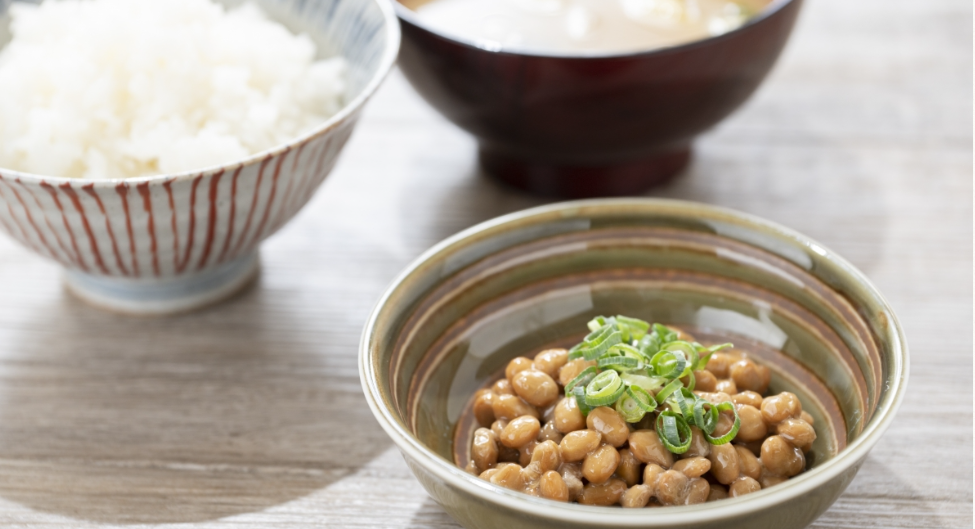
Every morning: miso soup, five minutes, off the heat before the miso goes in. On natto days, I eat it over warm rice with soy sauce, karashi mustard, and thinly sliced green onion — stirred fifty times, because my husband told me to years ago and I never stopped. The probiotic capsule goes down with my first glass of water, before breakfast. It takes no thought, which is part of why it works.
I started taking a supplement during a particularly stressful stretch — poor sleep, eating less carefully. The miso and natto didn’t stop. But I wanted the consistency that food couldn’t guarantee in that period. I’ve kept the habit because the friction is zero and the downside is minimal.
That’s the most honest thing I can tell you. It doesn’t have to be a dramatic intervention.
FAQ
Do I need a supplement if I already eat miso and natto daily? Not necessarily. If your digestion is settled and fermented foods are a genuine daily habit, you may already be doing more than most. If you’re curious, try one for 60 days and notice whether anything shifts.
How long before I notice a difference? Some people report changes within 1–2 weeks. A meaningful trial is 4–8 weeks of consistent daily use.
Is natto available in the US? Yes. Freezer section at Japanese and Korean grocery stores, Weee! delivery, or freeze-dried varieties on Amazon. Defrost overnight, stir with the included sauce and mustard, eat over warm rice. Give it three tries before deciding.
Which is best for women navigating hormonal shifts? Garden of Life is the most directly formulated for that context — L. reuteri and L. fermentum are the strains most studied in female physiology. Renew Life’s broad Bifidobacteria coverage is also relevant. Culturelle is a solid maintenance option but doesn’t make female-specific claims.
The Honest Answer
Neither the miso nor the capsule is the answer. Both are part of one.
Some mornings it’s a bowl of soup. Some mornings it’s a capsule washed down before the coffee is ready. In my house, most mornings it’s both — not because I’m optimizing, but because these habits have become quiet and familiar and mine.
If you’re just starting: pick one thing. The miso is cheaper and comes with centuries of cultural context. Culturelle is $20.99 and requires no chopstick skills. Either is a beginning.
Garden of Life → | Culturelle → | Renew Life →
Have you tried building a gut ritual of your own? I’d love to hear what’s working — or what surprised you — in the comments.
整う、ということは 完璧になることではなく、 毎朝、戻ってくること。
(To be in balance / is not to be perfect — / but to return, each morning.)
Hana is a J-Beauty writer based in Japan who spent most of her busiest years too busy to think about skincare — and paid for it in dullness, dryness, and a face that looked more tired than she felt. Now she writes about going slower and choosing better, for women who are finally ready to start.