Why DHC and TATCHA Are Different Products for Different Women
This post contains affiliate links. If you purchase through my links, I may earn a small commission at no extra cost to you. I only recommend products I genuinely use or have thoroughly researched.
I was in my busiest years when I stopped washing my face properly. Not skipping it entirely — just rushing through it, using whatever was closest, trusting that squeaky-clean feeling that I now know was my skin telling me something was wrong.
The tightness after cleansing. The dry patches that showed up before lunch. The shelf of serums I kept buying because surely something would fix the problem.
It took moving back to Japan — and spending real time understanding why Japanese women treat cleansing as the foundation of everything — to understand what I was missing.
If you’re reading this, you probably already know something has shifted. Your skin feels different. Cleansers that used to work now leave your face feeling papery. You’ve started wondering if there’s a gentler way.
There is. And it starts with the right oil.
In this article, you’ll learn:
- Why the tight feeling after cleansing is a warning sign, not a success signal
- The real difference between DHC’s olive oil formula and TATCHA’s camellia oil — and which one is actually right for your skin
- An honest note on SEKKISEI, including the ingredient most brands won’t mention
- How to double cleanse in under two minutes, the Japanese way
Quick-Win Comparison Table
| Category | Product | Why Hana Recommends It | Where to Buy |
|---|---|---|---|
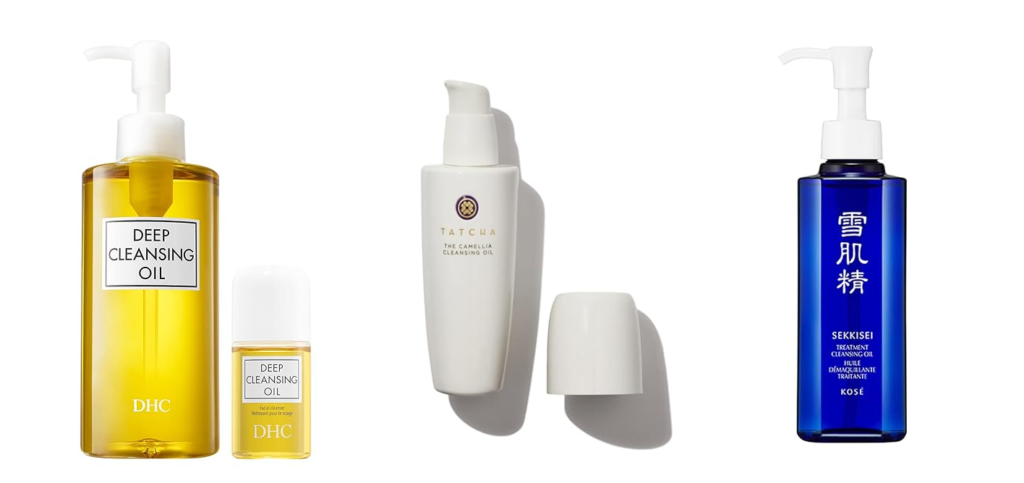
| Best Overall Value | DHC Deep Cleansing Oil (7.7 fl oz + travel size) | 8-ingredient formula, fragrance-free, $3.24/fl oz | Amazon → |
| Best for J-Beauty Ritual | TATCHA Pure One Step Camellia Cleansing Oil | Tsubaki + fermented rice, 2-in-1 | Amazon → |
| Best for Herbal Approach | SEKKISEI Treatment Cleansing Oil | Coix seed + angelica root; mineral oil base — see honest note | Amazon → |
| Hana’s Personal Pick | TATCHA for ritual nights; DHC for everyday | Depends entirely on what you need that evening | See below |
Patch test recommended before first use of any new cleanser, especially if your skin is currently reactive or sensitized.
The Night I Finally Understood What Cleansing Was For
I used to think the goal of cleansing was to feel clean. That tight, slightly raw sensation after a foaming wash — I thought that meant it was working.
It wasn’t working. It was stripping.
The shift came from understanding one Japanese concept: 丁寧 (teinei). It doesn’t translate cleanly into English. The closest is careful attention — but it’s deeper than that. It’s the idea that how you do something matters as much as what you use.
In Japanese skincare, 丁寧 lives in the cleanse. The emulsification step. The warm water rinse at the right temperature. These aren’t optional extras. They’re the work itself.
For skin navigating hormonal shifts — the particular kind of dryness that didn’t exist a few years ago, the sensitivity that shows up out of nowhere — this attention can make a genuine difference. Not because of the product alone. Because of the care behind it.
Which One Is Right for You — Honest Comparison
| DHC Deep Cleansing Oil | TATCHA Camellia Oil | SEKKISEI Treatment Oil | |
|---|---|---|---|
| Price / fl oz | $3.24 | $9.80 | $3.66 |
| Total size | 7.7 fl oz + 1 fl oz travel | 5.1 fl oz | 10.1 fl oz |
| Primary oil | Organic olive oil | Camellia (Tsubaki) + rice bran | Mineral oil |
| Fragrance-free? | ✅ Yes | ❌ No (Parfum, Limonene, Citral) | ❌ No (Parfum) |
| Mineral oil? | ✅ None | ✅ None | ⚠️ First ingredient |
| Key J-Beauty ingredients | Olive oil (refined in Japan), Vitamin E, licorice-derived Stearyl Glycyrrhetinate | Tsubaki oil, fermented rice, green tea, Okinawa mozuku algae | Coix seed (hatomugi), angelica root, sesame, safflower |
| Double cleanse needed? | Recommended | Optional (2-in-1 formula) | Recommended |
| US retail | Amazon, Ulta, Dermstore | Amazon, Sephora, Ulta | Amazon primarily |
| Ingredient count | 8 | 14 | 13 |
Who Should Choose DHC
You want something that works, costs almost nothing per use, and doesn’t require thought. You’re fragrance-sensitive. You’re new to oil cleansing and want a proven formula with a short ingredient list.
DHC’s formula is eight ingredients. The water-soluble formula emulsifies clean — no residue, no film, nothing. It doesn’t feel like oil after you rinse. It feels like nothing, which is exactly what good cleansing should feel like.
One honest note: rosemary leaf oil contains camphor — a known skin irritant — and cosmetic ingredient analyses note it can appear at concentrations up to 27% depending on chemotype. Pay attention the first week if your skin is currently sensitized.
Best for: Everyday use, fragrance-sensitive skin, those new to oil cleansing, double-cleanse routines Skip if: You react to rosemary or camphor, or prefer a single-step formula
Who Should Choose TATCHA
You want the cleanse to feel like something. You wear SPF and full makeup regularly. You’re drawn to the cultural story — and you want it to be real, not marketing.
Research has found that C. japonica seed oil contains oleic acid as the dominant fatty acid — at roughly 80% or more of total fatty acids, as documented in a PubMed lipid analysis. It has a long history of traditional cosmetic use in Japan for skin and hair care. And a study published in the Journal of Ethnopharmacology found camellia japonica oil can support skin barrier function and reduce transepidermal water loss.
Green tea extract’s antioxidant properties have a more established research base — studies published on PubMed suggest topical EGCG may help reduce UV-induced inflammation and oxidative stress in human skin, though most research has examined concentrated extracts, not rinse-off cleansing formulations specifically.
The fragrance is real and present. Limonene and Citral are listed as components. If your skin barrier is currently reactive, start with DHC first.
Best for: Those who want a 2-in-1 ritual, genuine Tsubaki/J-Beauty story, full SPF + makeup days Skip if: Fragrance sensitivity, or if the $9.80/fl oz cost needs more justification than you currently have
When to Consider SEKKISEI Instead
SEKKISEI is a 1985 Japanese brand from KOSÉ with genuine herbal heritage. The coix seed (hatomugi), angelica root, and safflower oils are traditional Japanese and Chinese botanical ingredients with a real history.
The honest note I have to give you: the first ingredient is mineral oil (Paraffinum Liquidum). The brand labels the product “non-comedogenic,” and mineral oil is widely considered to have low comedogenic potential in the cosmetic science literature — though no universally standardized rating scale exists. Many cosmetic chemists regard it as one of the safer occlusives for most skin types. But “mineral oil” is a term that reasonably makes some people hesitate, and you deserve to know it’s there.
US retail access is more limited than DHC or TATCHA. Amazon primarily.
Best for: Herbal and traditional Japanese skincare philosophy, skin that wants something more complex Skip if: You prefer mineral oil-free formulas, fragrance sensitivity, or need wide US retail access
What’s Actually in These Bottles
DHC’s 8-Ingredient Formula
Olea Europaea (Olive) Fruit Oil, Caprylic/Capric Triglyceride, Sorbeth-30 Tetraoleate, Pentylene Glycol, Tocopherol, Stearyl Glycyrrhetinate, Rosmarinus Officinalis (Rosemary) Leaf Oil, Phenoxyethanol.
Eight ingredients. That’s the whole list. The Sorbeth-30 Tetraoleate is the self-emulsifying surfactant that makes it rinse clean — that milky-white moment when the oil turns is this ingredient doing its job. Stearyl Glycyrrhetinate — a licorice-derived ester — is recognized in cosmetic science for its skin-soothing properties, as assessed by the Cosmetic Ingredient Review Expert Panel. Tocopherol is Vitamin E, working as an antioxidant.
Nothing here that shouldn’t be here.
TATCHA’s Camellia + Fermented Rice Formula
Key ingredients: Rice Bran Oil, Camellia Japonica Seed Oil, Saccharomyces/Rice Ferment Filtrate, Camellia Sinensis Leaf Extract, Cladosiphon Okamuranus (Okinawa mozuku) Extract, Tocopherol.
Camellia oil sits among the first four ingredients. The fermented rice filtrate and green tea extract are genuinely there — the antioxidant and skin-conditioning properties of these ingredients are better researched than many J-Beauty claims. TATCHA reports that their Hadasei-3™ complex delivers amino acids and AHAs through double fermentation; this is a brand-reported claim rather than independently published data.
The fragrance is present. Limonene and Citral are listed. Important to know before buying.
A Note on Oleic-Rich Oils for Both
Both DHC and TATCHA are oleic acid-dominant oils with similar emollient properties. For most people using these as rinse-off cleansers, they leave skin feeling softer and more comfortable than foaming cleansers. Some plant oil research, reviewed in PMC, has noted that oleic acid at high concentrations under continuous application can affect stratum corneum lipid packing — but the context matters significantly. Rinsing off a cleansing oil is not the same as leaving a high-concentration oil on the skin.
How to Use a Japanese Cleansing Oil — The Short Version
- Start dry. Dry hands, dry face. Water stops the emulsification before it starts.
- Use enough. 2–3 pumps. Too little creates friction; friction damages skin.
- Massage gently for 30–60 seconds. Fingertips only. Don’t rub.
- Add a small amount of water and continue massaging until the oil turns milky white. This is emulsification — the step most people skip.
- Rinse with lukewarm water — around 95–100°F. Check the hairline and jawline. Residue hides there.
- Follow with a gentle water-based cleanser if double cleansing (recommended for DHC and SEKKISEI). TATCHA can stand alone.
FAQ
Q: Is oil cleansing safe if my skin is combination — oily in some places, dry in others?
Yes, and it may help. Oil cleansers dissolve excess sebum without stripping, which can reduce the skin’s compensatory oil production over time. Give it three to four weeks before drawing conclusions.
Q: I’m worried about TATCHA’s fragrance — should I avoid it if my skin feels reactive?
That’s a fair concern. Limonene and Citral can trigger sensitivity in some people, particularly when the skin barrier is already compromised. If your skin is going through a reactive period, start with DHC — fragrance-free. Try TATCHA once your barrier feels more stable. If you notice any stinging or warmth during or after cleansing, trust that signal.
Q: How does oil cleansing fit with a retinol or active routine?
Well, actually — better than most cleansers do. A gentle oil cleanser removes SPF and makeup without compromising the barrier your retinol routine is simultaneously working to support. The most important step after any oil cleanse is immediate moisturization. Apply your next step within 60 seconds of patting dry.
What Hana Would Tell a Friend
If someone asked me which of these three to start with, I’d ask one question first: what do you actually want from your cleanser?
If she wants something reliable, quiet, and almost impossibly affordable — DHC. Eight ingredients. Fragrance-free. Made in Japan. The kind of product that disappears into a routine because it just works.
If she wants the cleanse to feel like a ritual — if she wants to hold a beautiful bottle and feel the tsubaki oil change texture in her hands — TATCHA. The price is real. So is the product.
If she’s drawn to herbal Japanese skincare rooted in traditional medicine, and the mineral oil conversation doesn’t concern her — SEKKISEI deserves a look. Just with full information.
There is no cleanser that will undo years of barrier stress in a week. But there is a cleanser that will stop adding to the problem — and that change is more significant than it sounds.
You’re not behind. You’re just starting to pay attention. That’s enough.
Shop DHC Deep Cleansing Oil → Shop TATCHA Camellia Oil → Shop SEKKISEI Treatment Oil →
Have you switched to oil cleansing? I’d love to hear what’s working — or not working — in the comments below.
The skin does not forget kindness. What you give it tonight, it holds.
Hana is a J-Beauty writer based in Japan who spent most of her busiest years too busy to think about skincare — and paid for it in dullness, dryness, and a face that looked more tired than she felt. Now she writes about going slower and choosing better, for women who are finally ready to start.