This post contains affiliate links. If you purchase through my links, I may earn a small commission at no extra cost to you. I only recommend products I genuinely use or have thoroughly researched.
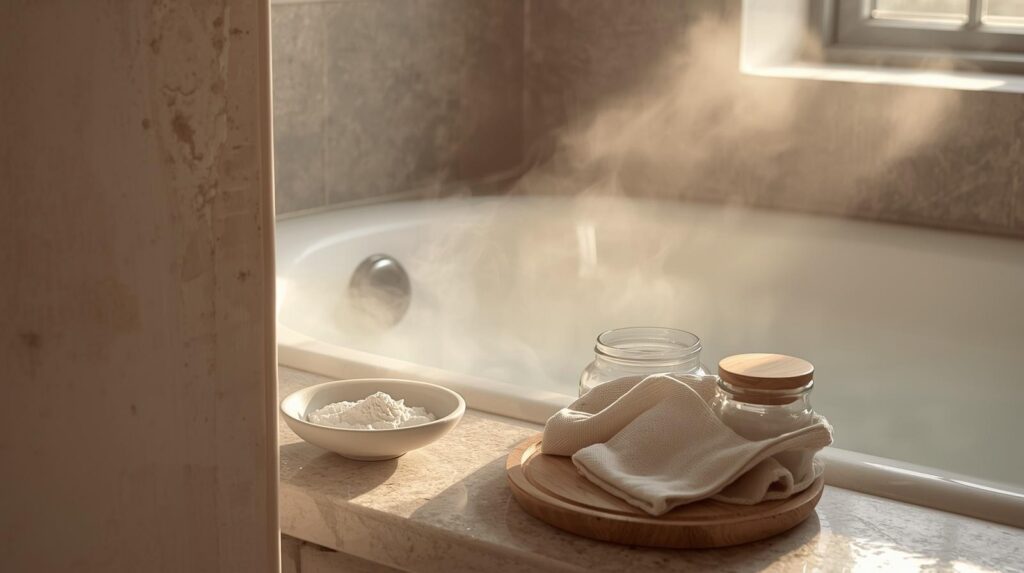
There’s a certain kind of tired that a shower can’t touch.
I know it because I lived in it for years. The kind where you get clean, technically, but you step out feeling exactly as wrung-out as when you stepped in. I kept adding things — salts, oils, fancy bath bombs that smelled like a department store had a mild emergency. Nothing landed. Nothing actually reset me.
Then I moved to Japan, and I learned something that changed how I think about baths entirely.
In this article, you’ll learn:
- What yunohana actually is — and why it forms inside mountains, not factories
- Where Okuhida’s powder comes from and what makes it different from other Japanese bath salts
- How it compares to Epsom salt and blended Japanese bath powders
- Whether it’s genuinely suitable for sensitive or reactive skin
- Exactly how to use it at home
Quick-Win Comparison Table
| Category | Product | Why Hana Loves It | Where to Buy |
|---|---|---|---|
| Best for sensitive skin | Yunohana (Okuhida Onsen) | No fragrances, no dyes, no synthetic anything | Amazon → |
| Best variety + value | Tabino Yado (Kracie) 26-pack | 26 baths, 8 onsen destinations, Japanese quasi-drug standard | Amazon → |
| Best budget entry point | Earth Meguri 15-pack | 15 baths for $17.46, nigori effect, great intro to onsen-style bathing | Amazon → |
| Hana’s personal pick | Yunohana (Okuhida Onsen) | The one I reach for when I need actual recovery, not just a nice smell | Amazon → |
| Best seasonal use | Yunohana or Tabino Yado | Both especially satisfying in colder months — the warmth genuinely lingers | — |
Patch test recommended before first use, especially if you have sensitive or reactive skin.
I was in my busiest years — working, managing everything, still washing my face with whatever bar soap happened to be in the shower — when a neighbor handed me a small paper envelope and said: “Just soak. Don’t do anything else.”
It was yunohana. The water turned white. I stayed in twenty minutes and got out feeling like something had been wrung out of me that I’d been carrying for weeks.
Autumn is when I feel it most clearly — the bath that doesn’t quite warm me the way I need it to, the tiredness that follows me into morning. That’s usually when I reach for the yunohana.
This is what 丁寧 — teinei — names. Not fussiness. Not a beauty routine with extra steps. It’s the act of bringing full attention to something ordinary so that it stops being ordinary. For women who are holding a lot right now, teinei is a quiet argument that this moment counts. Research published in PMC suggests warm water immersion may reduce cortisol and support cardiovascular benefits — and I can say from personal experience that the difference between a regular bath and this one is not subtle.
What Yunohana Actually Is (And Why the Name Means “Hot Water Flower”)
Yunohana (湯の花) translates, literally, as “hot water flower.” It’s a precise name.
Inside Japan’s hot spring pipes and steam channels, minerals dissolve into the water as it rises. As the water cools, evaporates, or meets oxygen at the surface, some of those minerals crystallize. The deposits that form — white, powdery, sometimes flower-shaped — are yunohana. They are the solid record of what the hot spring water carried.
The powder you add to your bath is those crystals, collected and refined. Nothing added. Nothing removed.
How yunohana crystals form — and where they’re harvested
In Beppu, Oita Prefecture, yunohana has been harvested for nearly 300 years using thatched huts built above geothermal steam vents. Hot spring gases rise into the hut and crystallize on the clay floor inside. This manufacturing method was designated an Important Intangible Folk Cultural Property of Japan in 2006.
The Okuhida powder reviewed here uses a different source — natural limestone deposits from the Hida Mountains of Gifu Prefecture — but the same principle applies: this is a material the mountain made over centuries, not a lab.
Why Okuhida’s yunohana is different
Okuhida yunohana is primarily calcium-based (石灰華, sekkaika — “limestone flower”). When calcium compounds meet your bath water, they suspend rather than dissolve cleanly, turning the water the characteristic milky-white that Japan’s famous nigori onsen are known for. No dye. No colorant.
Most Japanese bath salts — including excellent ones like Tabino Yado and Earth Meguri — are formulated mineral blends. They’re built around the experience of an onsen. That’s legitimate and effective. Yunohana is a different category: the raw mineral itself, without anything added.
Yunohana vs. Epsom Salt vs. Japanese Blended Bath Salts
| Yunohana (Okuhida) | Epsom Salt | Tabino Yado (Kracie) | Earth Meguri | |
|---|---|---|---|---|
| Main mineral | Calcium oxide (CaO), silica | Magnesium sulfate | Sodium sulfate, bicarbonate | Sodium carbonate, chloride |
| Fragrance | None | None / sometimes added | Yes — varies by type | Yes — 15 varieties |
| Water effect | Milky white (nigori) | Clear | Milky or clear | Milky (nigori) |
| Sensitive skin | ✅ Well-suited | ✅ Generally fine | ⚠️ Patch test | ⚠️ Patch test |
| Synthetic additives | None | None | Yes | Yes |
| Quasi-drug certified | No (natural mineral) | No | ✅ Yes (Japan) | ✅ Yes (Japan) |
| Price per bath | ~$1.13 | Very low | ~$1.35 | ~$1.16 |
| Best for | Sensitive/reactive skin, purists | Budget, muscle relief | Onsen experience | Variety + value |
The honest summary: Epsom salt is cheap and effective for muscle relief. Tabino Yado and Earth Meguri deliver a genuine onsen experience — the scent, the color, the ritual of choosing a destination. Yunohana delivers something closer to the mineral reality of an actual hot spring, stripped of everything else. Which one you want depends on what you’re asking the bath to do.
What’s Actually in the Powder
The primary mineral in Okuhida yunohana is calcium oxide — approximately 54% of the powder’s composition. The full profile: silicon oxide (silica) at ~1.25%, aluminum oxide at 0.08%, ferrous oxide at 0.07%, and potassium oxide at trace levels.
When calcium compounds dissolve in bath water, they suspend rather than disappear — scattering light and turning the water opaque and white. This is the same process behind Japan’s famous shirogane no yu (“silver spring”) onsen.
A PubMed-indexed review on the use of silicon for skin and hair care suggests silicon plays a role in collagen synthesis and skin quality — though most of the evidence concerns oral silicon supplementation rather than mineral bath exposure. The transdermal story is still developing. What I can tell you from experience is that the water feels different, and the skin afterward feels different. That’s worth naming, even without a complete mechanism.
No fragrance. No dye. No preservative system. For skin that reacts to synthetic fragrance — and research in Dermatologic Clinics notes fragrance allergy affects 0.7–2.6% of the general population — the absence of all of it matters.
How to Use Yunohana
Dosage and temperature: Fill your tub with warm water — 40°C (104°F) is the recommended range. Add one tablespoon (approximately 15g / 0.5 oz) of yunohana powder to the running water. Stir once and let it disperse.
Soak time: 15–20 minutes. No need to rinse off afterward.
Foot bath option: Half a teaspoon in a warm basin. Especially useful in colder months.
Heat retention: According to Bathclin, Japan’s largest bath additive manufacturer, mineral salts bond with skin proteins to form a veil that improves post-bath heat retention — a mechanism also noted in a Japanese industry review on J-STAGE. The peer-reviewed evidence is still building, but the sensation of warmth that lingers after a yunohana bath is something most people notice on the first soak.
After your bath: Rinse the tub. Calcium mineral leaves a white residue that wipes off easily but shouldn’t be left standing.
What to expect the first time: The water goes genuinely white — not tinted, white. There’s no fragrance. If you’re used to scented products, the absence might feel like something is missing. Give it five minutes. The skin feels softer afterward. Not dramatically — subtly, like the texture has been reset.
FAQ
Is yunohana the same as regular bath salts?
No. Most bath salts — including good Japanese ones — are formulated mineral blends: they combine active compounds with fragrances, colorants, and herbal extracts to recreate the feel of an onsen. Yunohana is the raw mineral deposit itself, without additions. It’s closer to what you’d encounter in an actual Japanese hot spring than a formulated product can be.
Can I use it if I have eczema or very dry skin?
Okuhida yunohana contains no fragrances, dyes, sulfur, or synthetic additives — the ingredients most commonly associated with skin reactivity. Some users with dry or reactive skin report their skin feels softer and calmer after use. That said, individual responses vary, and if you have a diagnosed condition, a conversation with your dermatologist before trying anything new is always the right call. Patch test recommended on first use.
Yunohana vs. Tabino Yado — which one should I start with?
If you want a sensory experience — beautiful colored water, a distinctive scent, the feeling of traveling to a specific onsen — start with Tabino Yado. It’s easier to love immediately. If you have reactive skin, or you want to get as close as possible to the mineral reality of a hot spring with nothing extra added, start with yunohana. Many people end up keeping both.
Closing
There’s no timeline you’re behind on here.
The bath will be there when you’re ready. What I want you to know is that the twenty minutes you spend in warm mineral water is not a reward you have to earn. It’s a tablespoon of powder in warm water. It’s twenty minutes of staying still.
You can find the Okuhida yunohana on Amazon here → Yunohana, $17.99 for 250g (~16 baths)
For comparison: Tabino Yado 26-pack → $34.99 · Earth Meguri 15-pack → $17.46
Have you tried yunohana or any Japanese onsen bath powder? I’d love to hear what’s working — or what surprised you — in the comments.
湯の花、湯の花、湯に咲く花よ Hot spring flower, hot spring flower, blooming in the water — the oldest beauty is the kind the mountain makes.
Hana is a J-Beauty writer based in Japan who spent most of her busiest years too busy to think about skincare — and paid for it in dullness, dryness, and a face that looked more tired than she felt. Now she writes about going slower and choosing better, for women who are finally ready to start.